
Key Takeaways
- Market gains broadened beyond big tech in August
- Oil prices remain a key inflation concern
- Interest rates face growing uncertainty
- Treasury and Fed priorities may increase market volatility
Stock Market Recap
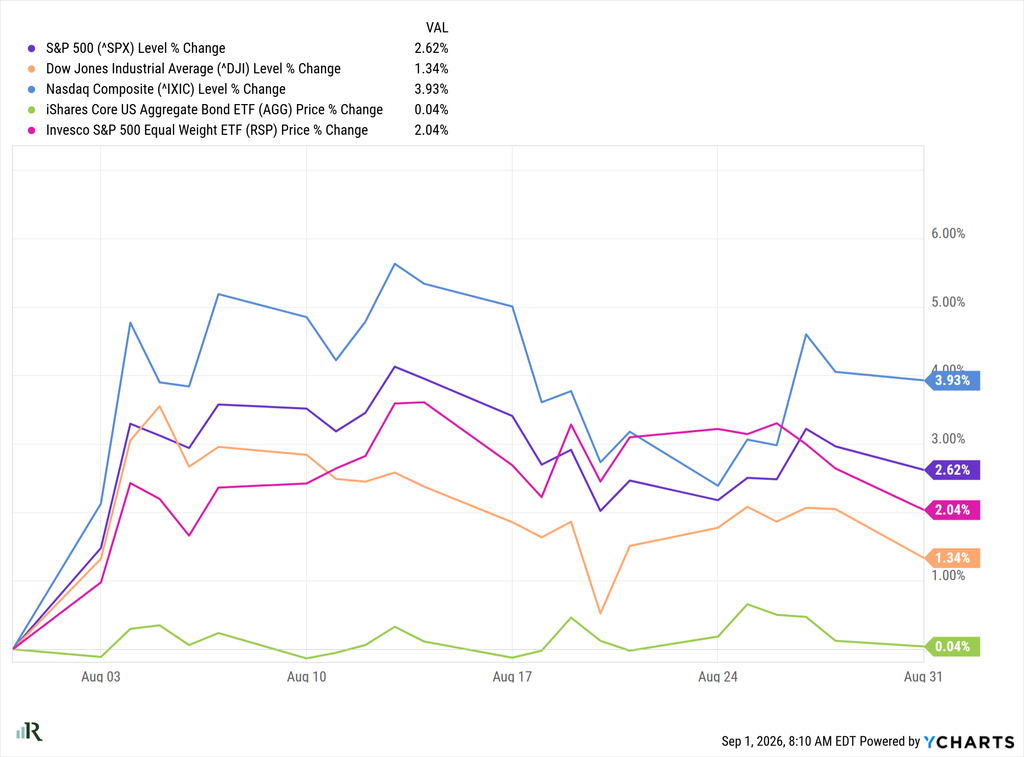
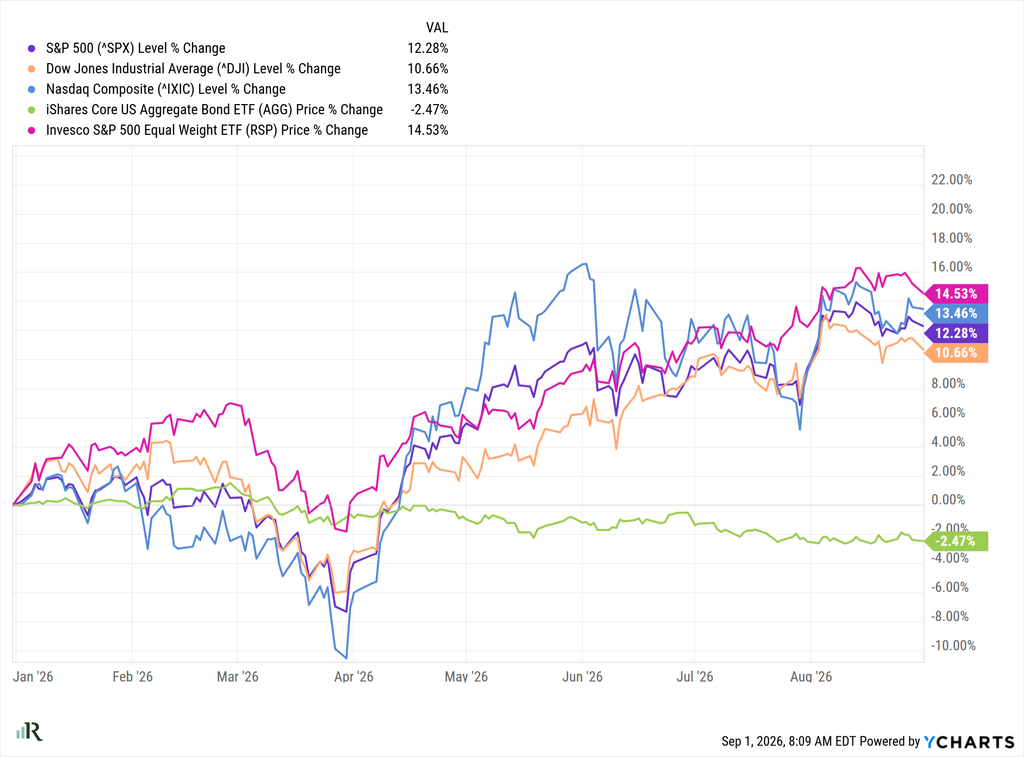
August turned out to be anything but a quiet month for the markets. While August is often a slower period for investors, the S&P 500 gained 2.62%, bringing its year-to-date return to 12.28%.
The market’s performance was positive, although the trading environment was fairly typical for late summer, with lower trading volumes and generally modest volatility. The technology-heavy Nasdaq also bounced back nicely after a weaker July, gaining 3.93% in August and bringing its year-to-date gain to 13.46%.
Perhaps most encouraging, however, has been the continued broadening of the market rally. The equal-weighted S&P 500, which gives each company the same weighting rather than allowing the largest companies to have an outsized impact, continued to perform well. It is now up 14.53% for the year.
This continued strength in the equal-weighted index is a positive sign because it suggests that the market’s gains are not being driven solely by a handful of the largest technology companies. More areas of the market are beginning to participate, which can provide a healthier foundation for the market’s continued progress.
Oil Prices
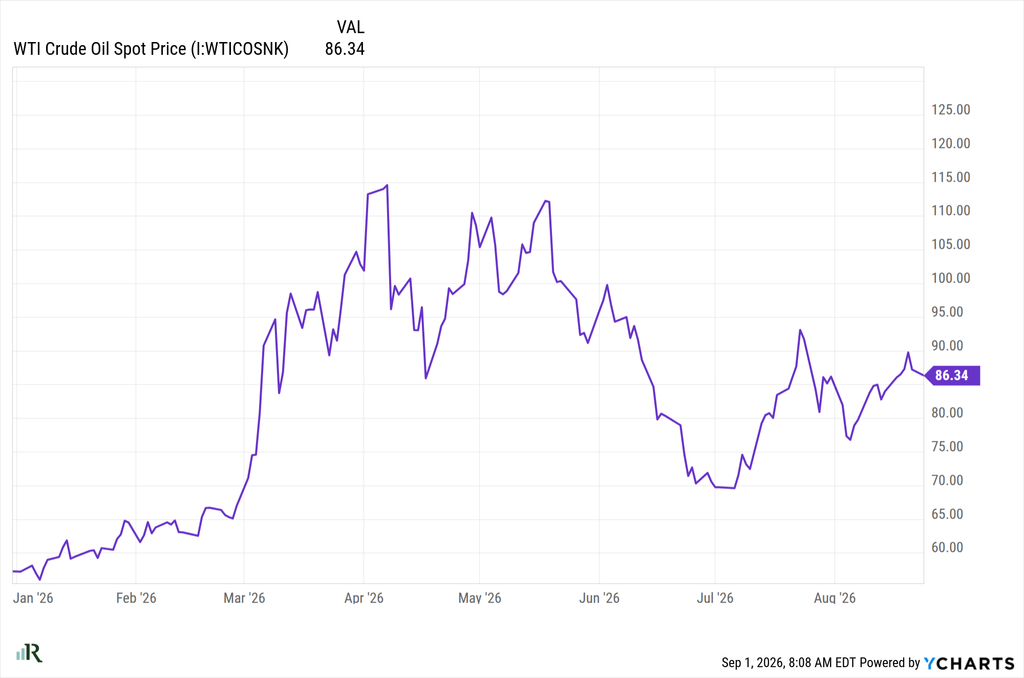
Oil prices continue to be an important topic for investors. While oil prices did not spike to extremely high levels during August, they also did not decline meaningfully. With uncertainty surrounding the conflict involving Iran, it may be difficult for oil prices to move significantly lower until there is more clarity on the situation.
Why does this matter to investors? Oil prices have a direct connection to inflation and, ultimately, to Federal Reserve policy. Higher oil prices can increase the cost of gasoline, transportation, and many other goods and services, putting upward pressure on overall inflation.
This creates a challenge for the Federal Reserve. If inflation remains elevated because of higher energy prices, it becomes more difficult for the Fed to justify cutting interest rates. In fact, if inflation were to accelerate meaningfully, the conversation could shift from potential rate cuts to the possibility of keeping rates higher for longer— or even considering a rate increase.
For now, oil prices remain something we will continue to watch closely, particularly because they could play an important role in both the inflation outlook and the direction of interest rates.
Interest Rates – Expectations Shifting
The outlook for interest rates has also become more interesting. The market-implied probability of an interest rate hike at the Federal Reserve’s September meeting has risen to approximately 64%. Historically, when that probability moves above 70%, the Fed has been much more likely to actually make a move.
Another development worth watching is the 2-year Treasury yield, which rose from approximately 4.20% to 4.40% during August. The 2-year Treasury is particularly important because its yield is closely tied to expectations for where the Federal Reserve’s short-term interest rates are headed.
With the Fed Funds Rate currently at 3.50%-3.75%, the gap between the Fed Funds Rate and the 2-year Treasury has widened to more than 0.50 percentage points. This suggests that the bond market is pricing in a higher likelihood that interest rates may need to remain elevated (or potentially move higher) than previously expected.
In short, both the market’s expectations and the bond market itself are sending a message that the path for interest rates may not be as straightforward as investors had hoped. We will continue to watch these indicators closely, particularly as the Fed weighs the competing pressures of inflation and economic growth.
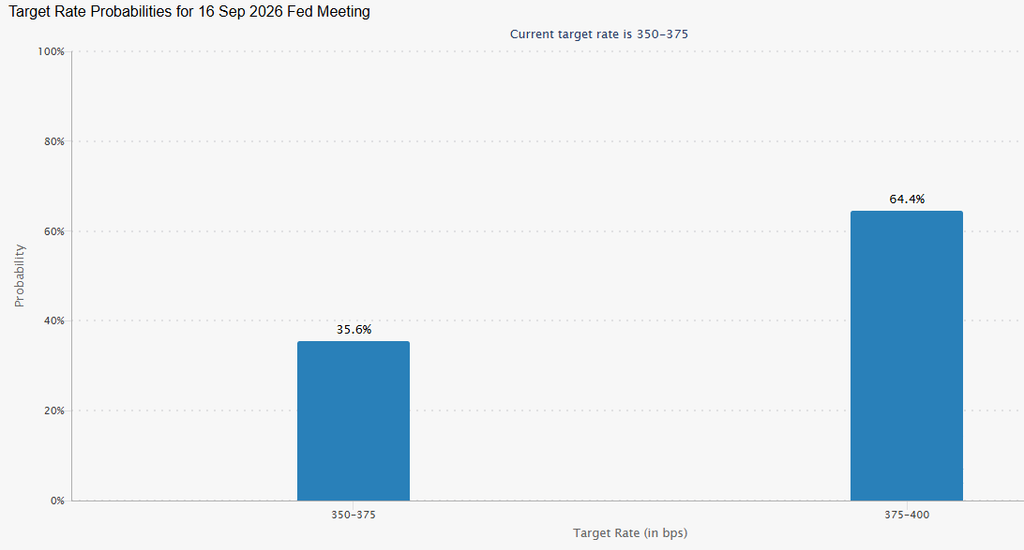
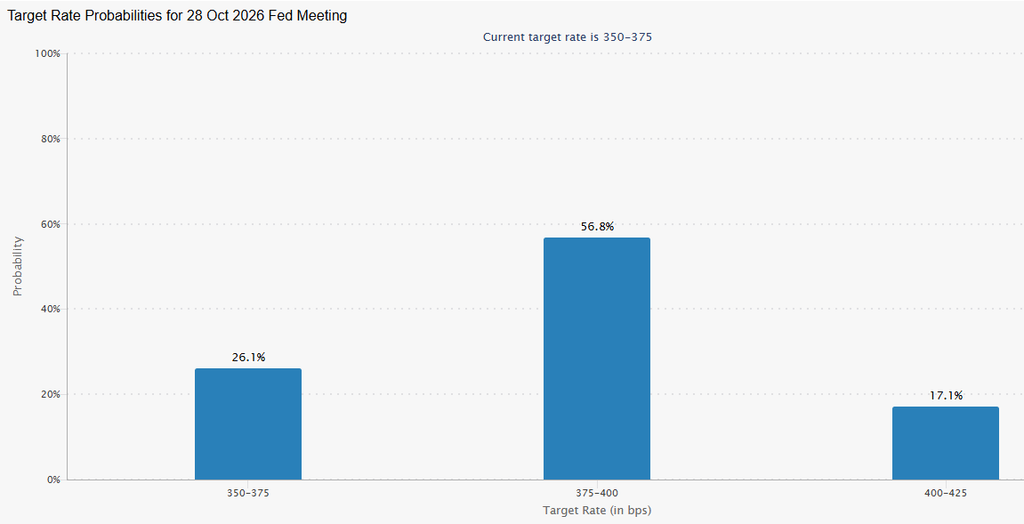
Source: CME FedWatch Tool – CME Group
The Treasury-Fed Balancing Act
Lastly, there is an interesting dynamic developing between the Treasury and the Federal Reserve that will be important to watch. Treasury Secretary Scott Bessent has been pushing for lower bond yields, including increasing Treasury’s purchases of bonds. The government’s desire for lower borrowing costs is understandable given the enormous amount of federal debt that will need to be refinanced over time— more than $40 trillion.
At the same time, Federal Reserve Chairman Kevin Warsh has continued to take a relatively hawkish tone, suggesting that interest rates may need to remain higher, or potentially move higher, if inflation remains a concern.
This creates an interesting situation. The Treasury would like to see borrowing costs come down, while the Federal Reserve’s focus remains on keeping inflation under control and maintaining appropriate monetary policy. Those objectives do not always point in the same direction.
There are still a lot of moving pieces, and this is something we will be watching closely. The interaction between Treasury borrowing needs, bond yields, inflation and Federal Reserve policy could have an important impact on both the bond and stock markets in the months ahead. There is certainly a lot to sort out here.
As we move beyond the quieter days of late summer, there are several important issues that still need to be worked through, particularly around inflation, oil prices, interest rates and government borrowing. With so many moving pieces, we should expect markets to experience more frequent swings in asset prices as investors react to new economic data and changing expectations.
While increased volatility is not necessarily a cause for concern, it is a good reminder that markets rarely move in a straight line. As always, we will continue to monitor these developments closely and make adjustments when appropriate.
Information as of 9.9.26
Securities offered by Registered Representatives through Private Client Services, Member FINRA/SIPC. Advisory products and services offered by Investment Advisory Representatives through Rockport Wealth LLC, a Registered Investment Advisor. Private Client Services and Rockport Wealth LLC are unaffiliated entities. The opinions contained herein are that of the authors not necessarily that of Private Client Services LLC and there should not be any guarantees assumed from the information presented.
Investments in securities do not offer a fixed rate of return. Principal yield and/or share price will fluctuate with changes in market conditions, and when sold or rendered, you may receive more or less than originally invested. No system of financial planning strategy can guarantee future results. Investors cannot directly invest in indices. Past performance does not guarantee future results. The performance numbers we mention are indexes. If you’re a client, we manage a custom portfolio for your particular situation and the performance will be different. You cannot invest directly in an index. Investing in an index fund involves fees and will reduce your overall return compared to the index.
Charts produced at yCharts.com
Rockport Wealth Advisors is a DBA of Rockport Wealth, LLC, a fee-based Registered Investment Adviser (RIA) registered with the Securities and Exchange Commission and offering a full range of professional services. The scope of any financial planning and/or consulting services to be provided depends upon the needs of the client and the terms of the engagement. Please see our CRS & ADV disclosure documents for more information about our business.